

Why Memory Matters in Childhood
Memory is essential for everyday tasks, like following instructions or finding belongings. Thankfully, supporting your child’s memory doesn’t need to be complex.
Everyday moments, like dinner chats or bedtime stories, can become DIY brain-enriching activities that naturally strengthen memory through parent-led play.
For deeper support, scientific brain training offers structured, evidence-based methods to systematically build memory and other cognitive skills.
In this article, we’ll explore how to combine home-based strategies with BrainFit’s targeted programmes to give your child the best possible support.
Understanding Childhood Memory
Before diving into exercises, it’s helpful to understand what memory means for a child’s developing brain. Memory isn’t just one skill, it’s a collection of processes that help your child take in information, store it, and retrieve it when needed. These include:
- Working memory – holding and manipulating small bits of information (e.g., remembering a number long enough to write it down).
- Short-term memory – storing recent events briefly (e.g., recalling what was just said in a story).
- Long-term memory – building lasting knowledge and experiences (e.g., remembering how to spell a word or tie shoelaces).
Memory supports learning, focus, and emotional control. Children with strong working memory can follow instructions, stay organised, and complete tasks more easily, while weaknesses can lead to frustration and low confidence.
The good news? Memory is highly trainable in early childhood thanks to brain plasticity. Engaging in memory-challenging activities helps build stronger, more efficient brain networks. Give your child the brain boost they deserve. Get started with a personalised BrainFit evaluation through our assessment.
While DIY brain-enriching activities offer natural support, scientific brain training provides structured, personalised programmes for even greater progress.
Understanding how memory works empowers you to support your child both at home and with professional tools when needed.
DIY Brain-Enriching Activities at Home
As a parent, you don’t need fancy tools or complex routines to support your child’s memory. In fact, some of the most effective DIY memory exercises are woven into everyday life, if you know what to look for. These DIY brain-enriching activities turn ordinary moments into fun and enriching memory boosters, helping your child strengthen recall, attention, and sequencing without even realising they’re “training”.
Try these fun, everyday activities to strengthen your child’s memory:
- Story Retelling – After a story or show, ask your child to recall events in order. Prompt with questions like “What happened first?”
- Recipe Recall – Let them help in the kitchen by remembering steps or ingredients. It builds working memory in a hands-on way.
- Memory Scavenger Hunts – Use clues like “Find something red” to engage visual memory and attention.
- “What’s Missing?” Game – Show objects, hide one, and ask what’s missing. Gradually increase difficulty for greater challenge.
Incorporate memory practice into daily routines, like reciting steps while brushing teeth or recalling the day before bed. These small, consistent moments build memory and create lasting connections.
Scientific Brain Training: The BrainFit Way
While DIY brain-enriching activities provide a wonderful foundation, there are times when more structured and targeted approaches are needed, especially if your child shows signs of struggling with memory, attention, or confidence. This is where scientific brain training comes in.
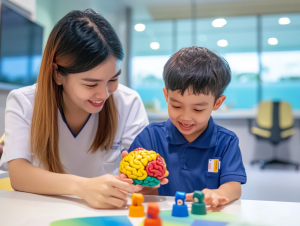
At BrainFit, we don’t guess, we assess. Our journey begins with the CognitiveMAP Assessment, a scientifically designed tool that measures a child’s brain fitness across five core pillars:
- Attention
- Visual & Auditory Processing
- Memory
- Logic & Reasoning
- Motor Coordination
Memory training targets how efficiently your child’s brain stores and retrieves information. At BrainFit, we begin with a personalised cognitive profile, then design a plan using our Smart Workout sessions, scientifically designed exercises that adapt in real time.
For instance, a child might do visual sequencing tasks that become gradually harder as their skills grow. This approach challenges the brain just enough to promote lasting improvement without causing frustration.
The outcome? Not just stronger memory, but better focus, instruction-following, and academic confidence.
Unlike DIY games, scientific training offers structured, measurable progress, and when combined with home routines, the impact is even greater.
Everyday Routines that Strengthen Memory
Memory isn’t only built through focused activities, it’s shaped daily by your child’s habits, environment, and routines. The most powerful memory improvements often come from consistency, and the good news is that small tweaks to your everyday life can make a big difference.

Let’s look at the best daily routines to strengthen kids’ memory, and how you can integrate them with both DIY memory exercises and scientific brain training:
1. Prioritise Sleep for Memory Consolidation
Sleep is when the brain organises and stores the day’s experiences. A consistent bedtime routine and adequate rest are essential. Sleep deprivation, even mild, can significantly reduce a child’s ability to concentrate and recall.
2. Fuel the Brain with Memory-Boosting Nutrition
A balanced diet rich in omega-3s, leafy greens, berries, and whole grains can support memory. Try incorporating these into meals in fun ways—like “brain-boosting smoothies” or memory-themed lunchbox challenges where your child remembers what’s inside.
3. Incorporate Physical Activity
Movement stimulates brain-derived neurotrophic factor (BDNF), a protein linked to memory and learning. Activities like dancing, cycling, or even skipping in the garden help improve oxygen flow to the brain and support mental alertness.
4. Create Moments for Mindful Reflection
Downtime doesn’t mean screen time. Encourage journaling, quiet drawing, or simple conversation about the day. Asking questions like “What was your favourite part of today?” strengthens recall and emotional memory.
5. Build Predictability and Sequencing into Routines
Children thrive on structure. Establishing clear daily routines (e.g., getting dressed in a certain order, packing a bag from memory) helps reinforce sequence memory. These routines also offer ideal moments to integrate DIY brain-enriching activities naturally.
BrainFit Programmes for Memory and Beyond
At BrainFit, we understand that no two children think or remember quite the same way. That’s why our programmes are carefully designed to meet children at their current cognitive stage and help them build stronger, more efficient brains through both scientific brain training and guided play.
We don’t just focus on memory in isolation; we develop it alongside attention, processing speed, and executive function for well-rounded brain fitness. Let’s explore how each of our signature programmes supports child memory improvement at different stages of development.
BrainFit Baby (Ages 9 – 36 months)
Memory begins to take shape far earlier than most parents realise. BrainFit Baby uses multisensory guided play to stimulate memory through routines, repetition, and emotional engagement. Activities such as rhythm play, object permanence games, and early language routines help lay the neural groundwork for memory formation.
BrainFit Junior (Ages 4 – 6 years)
This is the age when working memory becomes especially important for learning to follow instructions, listen attentively, and start reading. BrainFit Junior targets both visual and auditory memory using structured play-based exercises. Children practise recalling sequences, following multi-step directions, and sharpening memory through movement and sound.
BrainFit Scholar (Ages 7 – 18 years)
As children transition to more demanding academic environments, memory plays a central role in mastering subjects and managing responsibilities. BrainFit Scholar builds higher-order memory strategies through customised training plans based on the CognitiveMAP Assessment. These sessions may include digital platforms like Smart Workout app, which adapts in real time to challenge and strengthen a child’s memory capabilities.
Making It Work: A Balanced Approach for Parents
As a parent, you don’t need to choose between DIY methods and science; you can combine them. The most effective memory support comes from weaving together everyday interactions with structured training. It’s not about doing more, but doing what matters most, which is consistently.
Start by noticing the opportunities in your daily routine. Dinner conversations, car rides, bedtime stories, these are all chances to try DIY brain-enriching activities. They’re fun, simple, and help embed memory-boosting habits into your child’s everyday life.
At the same time, be open to the idea that some children need more targeted, scientific brain training to strengthen their cognitive foundation. If your child struggles with remembering instructions, following through on tasks, or retaining classroom content, BrainFit can help. Our personalised programmes are built to work with your child’s natural strengths while gently improving weaker areas, like memory.
The key is balance. Use DIY tools to stay engaged and present in your child’s learning journey. Turn to structured, evidence-based support when your child needs more than casual practice can offer. Memory isn’t built overnight, but with the right approach, it can become one of your child’s strongest assets.
Frequently Asked Questions (FAQ)
Q1. How early can I start memory training with my child?
Memory training can begin as early as infancy. During the first three years, the brain forms millions of connections daily. Simple routines like repeating songs, playing peekaboo, and narrating daily activities can serve as gentle DIY memory exercises that build early recall skills.
Q2. What’s the difference between brain training and tutoring?
Tutoring often focuses on subject-specific knowledge (e.g., maths or reading), while scientific brain training strengthens the core brain functions, like memory, attention, and processing speed, that make learning possible. BrainFit targets the root causes of learning struggles, not just the symptoms.
Q3. How do I know if my child’s memory is improving?
Look for everyday signs: your child may begin remembering multi-step instructions, recounting stories more accurately, or showing greater confidence in schoolwork. At BrainFit, we also use the CognitiveMAP to track measurable gains in memory and other cognitive domains over time.
Q4. Can I do these exercises at home without special tools?
Absolutely. That’s the value of DIY brain-enriching activities, they’re based on play and conversation, not equipment. You likely already have everything you need at home to start building your child’s memory through everyday routines.
Q5. How does BrainFit track memory improvements?
Progress is tracked through regular assessments and in-session performance reviews. Our trainers adjust each child’s plan based on how their brain responds, ensuring that memory training stays personalised and effective.
Building a Brighter Memory, One Day at a Time
Supporting your child’s memory doesn’t have to feel overwhelming. From shared conversations at the dinner table to guided sessions with a trained specialist, there’s a wide spectrum of opportunities to nurture their cognitive growth. What matters most is your commitment to showing up consistently, patiently, and with curiosity.
Through DIY brain-enriching activities, you can turn daily life into a powerful memory training playground. And with the support of scientific brain training, such as BrainFit®’s personalised programmes, you can provide your child with the structure and support they need to thrive.
Remember, memory is more than just recalling facts, it’s the glue that holds learning, relationships, and confidence together. With the right routines, tools, and guidance, your child can develop not just a sharper memory but a stronger foundation for success in school and in life.
Ready to see the difference? Take our assessment and discover your child’s unique learning profile today!
References:
https://pmc.ncbi.nlm.nih.gov/articles/PMC7984096
https://en.wikipedia.org/wiki/Memory_development
https://www.healthline.com/health/synaptic-pruning
https://pmc.ncbi.nlm.nih.gov/articles/PMC3222570
https://specialedresource.com/memory-activities-for-kids
https://faculty.washington.edu/chudler/chmemory.html
https://brainworkout.brainfit.com.sg
https://www.brainfit.co.th/en/our-courses/brainfit-scholar-programmes
https://www.americaskidsinmotion.com/the-impact-of-healthy-daily-routines-for-children
https://www.cdc.gov/healthy-weight-growth/tips-parents-caregivers/index.html
https://brainfit-ph.com/brainfit-programs
https://brainfit.com.sg/resources/brain-fitness/cognitivemap